
1. Leadership Philosophy & Coaching Pedigree
In the high-stakes environment of mid-major collegiate baseball, the infusion of Major League-level leadership acts as a force multiplier for player development. For a program like Hofstra, professional pedigree isn’t just a recruiting tool; it is a strategic blueprint that translates to “big league” culture—prioritizing mental resilience and technical refinement over raw tools. Implementing this professional DNA is essential for navigating a conference like the CAA where tactical execution often bridges the gap between mid-major resources and elite-level competition.
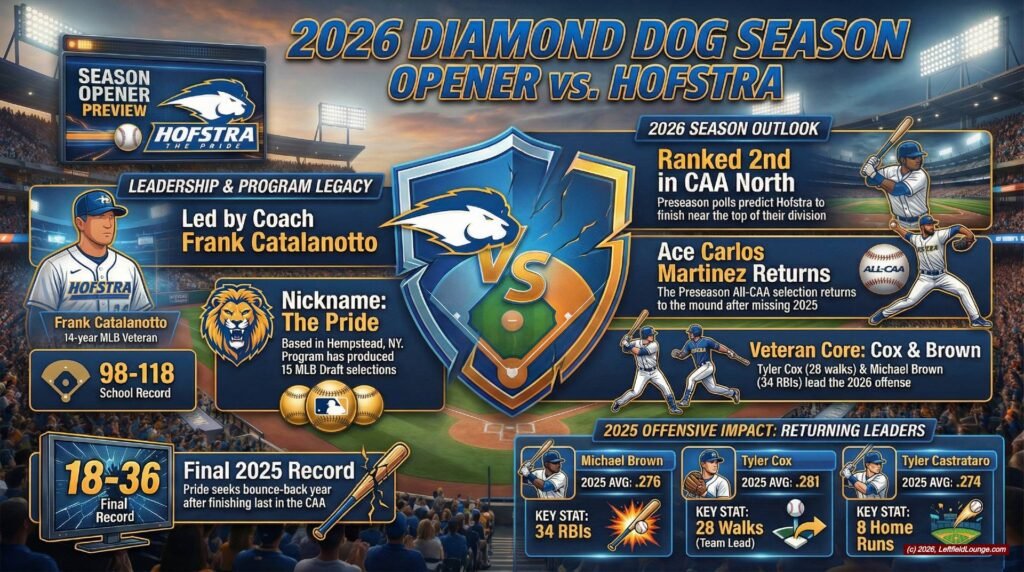
Head Coach Frank Catalanotto enters his fifth season with a resume that commands immediate respect. A 14-year MLB veteran, Catalanotto’s career trajectory—transitioning from a Division II World Series appearance with New York Tech in 2019 to securing a CAA title and NCAA Regional berth with Hofstra in 2022—proves his developmental model works. While his Hofstra record sits at 98-118 (144-139 overall), his professional stature has successfully professionalized the program’s competitive atmosphere. To return to the winner’s circle, however, his veteran coaching staff must now address the fundamental defensive and pitching lapses that derailed the 2025 campaign.
This stabilization begins on the mound, where the return of a frontline “stopper” is intended to reset a rotation that lacked an identity last spring.
2. The Pitching Rotation: Anchoring the Defense
The 2025 season was a statistical anomaly that the Pride cannot afford to repeat. Surrendering 499 runs on 566 hits led to a bloated 8.63 team ERA, but the deeper analytics reveal a command-and-control crisis: 337 walks over 450.2 innings. This translates to a staggering 6.73 walks per nine innings (BB/9), a metric that puts unsustainable pressure on the defense and bullpen. Rectifying this requires more than just health; it requires a rotation capable of reclaiming the zone.
The return of Carlos Martinez is the primary catalyst for this turnaround. A Preseason All-CAA selection and 2024 First Team performer, Martinez provides a “command-over-stuff” profile that was sorely missing during his 2025 injury hiatus. His presence stabilizes the staff by eating high-leverage innings, effectively reducing the exposure of a bullpen that struggled to strand runners last year.
2026 Projected Rotation
| Player | Class | 2025 Stat Line / Status | Strategic Role |
| Carlos Martinez | Senior | Missed 2025 (Surgery) | Front-line Ace: High-IQ stopper to reset the rotation hierarchy. |
| Sean Hamilton | Senior | 7.30 ERA; 40.2 IP; 35 K | High-floor Workhorse: Reliable veteran expected to increase volume. |
| Christian Rasmussen | Sophomore | 11.20 ERA; 13.2 IP | Mid-week Starter/Long Relief: Looking for sophomore jump in command. |
| Nick Reese | Freshman | First Season | Projectable LHP: Depth arm with the frame to earn high-leverage looks. |
Beyond Martinez, the Pride’s ceiling depends on the development of Sean Hamilton and sophomore Christian Rasmussen. Hamilton has shown flashes of durability, but the staff’s overall mission must be the reduction of free passes. If this unit can lower the walk rate toward a more competitive 3.5–4.0 BB/9 range, they will provide the offensive engine the breathing room necessary to outpace CAA opponents.
3. Offensive Architecture: Veteran Core & Run Production
Hofstra’s 2025 offensive output (.282 AVG, 328 runs) was productive but often neutralized by defensive inefficiency. The 2026 objective is to maintain this efficiency while bridging the “speed gap” left by the departure of Dylan Palmer, whose 32 stolen bases accounted for nearly a third of the team’s total. The Pride must now rely on a collective approach to maintain their elite 85% stolen base success rate (98-of-115).
The veteran anchor is Tyler Cox, a second-generation student-athlete who embodies the “high-baseball IQ” typically found in legacy players. Cox led the team with 28 walks in 2025, posting a .413 OBP that provides a psychological and statistical floor for the lineup. His plate discipline is the model for a roster looking to force opposing pitchers into high pitch counts.
Projected Field Positioning & Impact:
- Infield Power: Tyler Castrataro (So.) returns as the primary slugger. His 8 home runs and .469 SLG% in 2025 suggest a high ceiling for run production in the middle of the order.
- Contact Consistency: CJ Griggs (So.) provides a reliable bat at DH/C. His .309 average in 30 starts highlights a high-contact profile that balances the power threats.
- Defensive Stabilization: Michael Brown Jr. (Jr.) returns at shortstop. While his .276 average is steady, his 9 errors in 2025 highlight an area for refinement; the influx of graduate transfers at the corners should allow him to focus on range and fundamental execution.
A critical strategic adjustment involves battery management. While Hofstra’s runners were efficient, the catching corps allowed 119 steals on 144 attempts. Tightening the running game on the defensive side is a non-negotiable requirement for protecting narrow leads in conference play.
4. Integration of New Talent & Personnel Influx
Following an 18-36 season, a culture reset was necessary. Hofstra welcomes 14 new players to the clubhouse, a massive turnover intended to address the “Youth Gone Wild” volatility of 2025, where freshmen were forced to take 37.5% of the team’s at-bats. To mitigate this, Catalanotto has prioritized “high-floor” graduate transfers with experience in elite environments:
- Danny Corona (Gr., Missouri): An SEC-tested infielder (6’3″, 215 lbs) who brings much-needed physicality and veteran composure to the corner infield.
- JJ DeVito (Gr., St. John’s): A Big East veteran who provides a high-IQ approach in the outfield and a professional plate appearance every time he steps into the box.
Players to Watch:
- Deuce Musial (So.): At 6’5″, 215 lbs, Musial possesses a projectable frame that scouts prioritize. As the great-great-great nephew of Hall of Famer Stan Musial, his “legacy makeup” suggests a player who understands the nuances of the game beyond his years.
- Gabriel Melara (Jr.): A JUCO transfer from Skyline who offers defensive flexibility and a mature hitting profile, likely serving as a utility bridge across the infield.
5. Competitive Assessment: Strengths, Vulnerabilities, and CAA Outlook
The 2026 CAA North Division is defined by a significant logjam; Hofstra, Stony Brook, and Towson are currently tied for second in the predicted order of finish. This suggests a highly volatile division where a single weekend series could determine postseason eligibility.
Strategic SWOT Analysis
| Strengths | Weaknesses |
| • Professional Leadership (Catalanotto/MLB Staff) • Elite Stopper (Carlos Martinez) • High-Efficiency Running Game (85% success) | • 8.63 Team ERA (2025) • Defensive Battery Management (119 SBs allowed) • Significant speed loss (Dylan Palmer) |
| Opportunities | Threats |
| • Roster Overhaul (14 new faces reset culture) • Sophomores entering maturation phase • Three-way tie in CAA North (Power Vacuum) | • Command Crisis (6.7 BB/9 walk rate) • Opening series at #6 Mississippi State • Offensive reliance on new transfers |
Competitive Impact of the Schedule The season opens with a trip to Starkville to face #6 Mississippi State—a “decade-overdue” showdown after a 2014 blizzard famously cancelled their last scheduled meeting. This “baptism by fire” at Dudy Noble Field will immediately expose whether the staff’s command has improved. Within the CAA, the rivalry series against Northeastern and the “Battle of Long Island” with Stony Brook remain the primary hurdles to a North Division title.
Verdict Hofstra is a prime “bounce-back” candidate. The roster turnover has successfully raised the team’s floor by replacing inexperienced freshmen at-bats with SEC and Big East graduate experience. However, the path to the NCAA Regionals is entirely dependent on the strike zone. If Martinez returns to form and the staff cuts the walk rate by 30%, this group has the veteran makeup and power potential to recreate the 2022 championship run. Without command, the talent influx will merely be a cosmetic fix for a structural problem.
Disclaimer: This report was created with the assistance of AI, but edited by humans for accuracy and relevance.